
Pingtan's artisan preserves natural beauty through two decades of stone carving innovation
en.ptnet.cn | Updated:2025-11-14 | Lin Kongbo, StephanieNestled on the southeastern coast of China, Pingtan–a vibrant island known for its coastal landscapes and rich cultural heritage–is home to Zheng Erhua, a master stone carver who has dedicated over 20 years to transforming raw materials into exquisite works of art. His latest creation, "Life is a Drama – Cyan Robe·Sea Charm," recently claimed the Silver Award in the Other Carvings category at the 13th Fujian Arts and Crafts Excellence Competition, a prestigious event featuring nearly 1,400 entries across 19 craft categories from across the province.
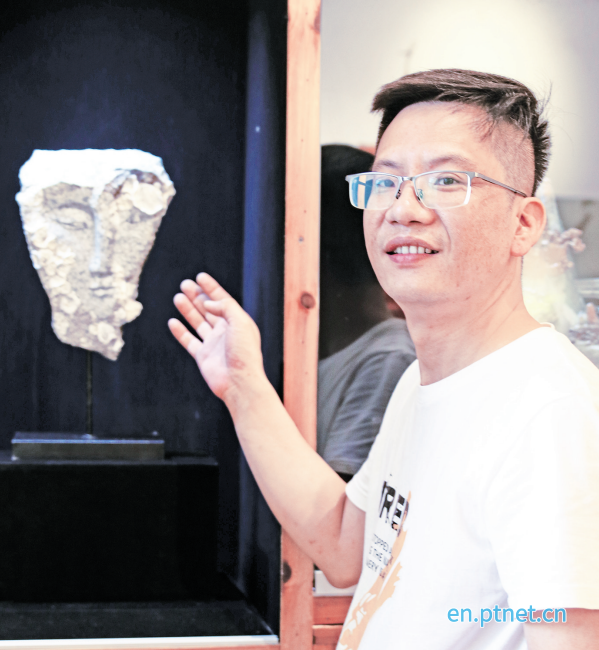
Shell stone carving: "Mutual Guard"
Zheng's artistic journey took an innovative turn when he discovered "shell stone" – a type of granite embedded with oyster shells – during a trip to his hometown Liushui Village. "Why limit stone carving to Shoushan stone or jade?" he recalls thinking. "These coastal stones, marked by shells, are the very soul of Pingtan." Carving shell stone is no easy task: the material is hard yet brittle due to seawater immersion, requiring careful water grinding and precise control to preserve the delicate shell inlays. "Carving shell stone means balancing strength and gentleness," Zheng explains. "Its unyielding texture mirrors the resilience of Pingtan people facing coastal winds and waves."
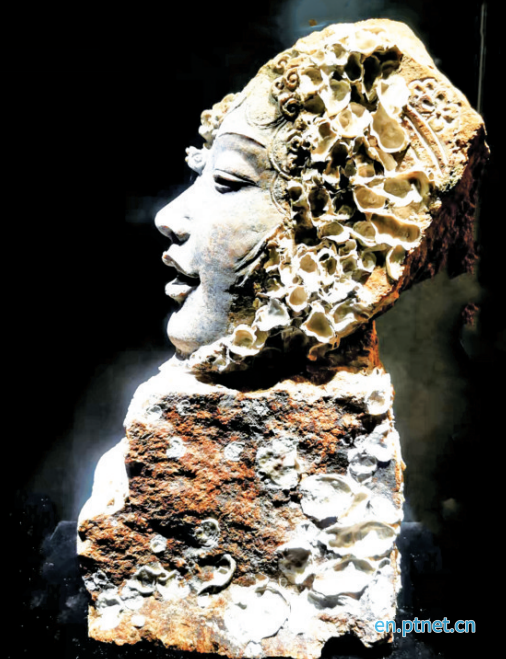
Shell stone carving: "Life is a Drama – Cyan Robe·Sea Charm"
"Life is a Drama – Cyan Robe·Sea Charm" exemplifies this approach. Zheng retained the stone's natural shape, carving a graceful profile of a traditional opera singer on its smooth side, while the shell-studded raised section serves as her elaborate headdress. Another notable work, "Mutual Guard," features a rounded shell stone carved with a face blending soft feminine lines and sharp masculine contours. "It tells the ancient philosophy of mountain and sea coexisting, yin and yang complementing each other," Zheng notes, "a metaphor for profound emotional bonds – long-term companionship and spiritual unity."
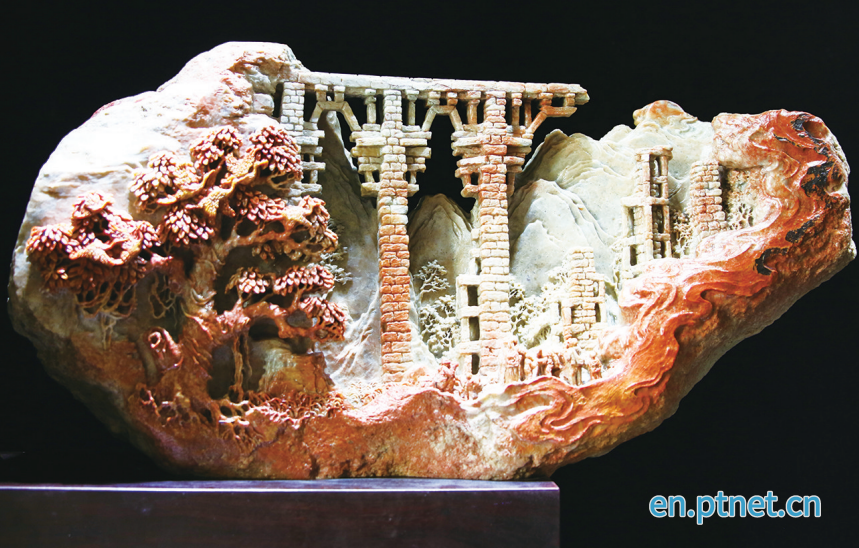
Stone carving: "Grateful for the Source"
Beyond shell stone, Zheng's portfolio includes "Grateful for the Source," inspired by an ancient irrigation canal in Pingtan. The work captures the canal's weathered texture, with red and white stone veins forming its winding course, accompanied by carvings of villagers working and chatting. "I was deeply shocked by the canal's exquisite craftsmanship," he says. "Water once flowed through it to nourish the land; people should similarly move forward with gratitude." The piece reflects a lesson from his mentor: "Knowledge can be found everywhere if you pay attention," a principle that has guided his artistic career.
Based at "Erhua Residence," a studio converted from an old stone house, Zheng has expanded his mission to pass on the craft. As a training teacher at a local vocational college, he pioneered a hybrid teaching model combining AI design, digital manufacturing, and hand carving. His Stone Carving Inheritance and Innovation Studio has trained over 100 students to date. "These stones from my hometown are more than materials," Zheng says. "I want to carve them into a tangible Shan Hai Jing of Pingtan. The "Shan Hai Jing" (Classic of Mountains and Seas) is a 2,000-year-old Chinese text blending mythology, geography, and folklore–a cultural cornerstone filled with tales of sacred mountains, exotic creatures, and natural wonders. For Zheng, his carvings are a modern, tactile version of this classic: just as the "Shan Hai Jing" preserved ancient stories of the land, his works capture Pingtan's coastal essence, local heritage, and natural textures in stone.


 Fujian Public Security Registration Code: 35012802000271