
Silent Baisha: A homecoming in stone and sea
en.ptnet.cn | Updated:2025-12-30 | Lin Kongbo, Stephanie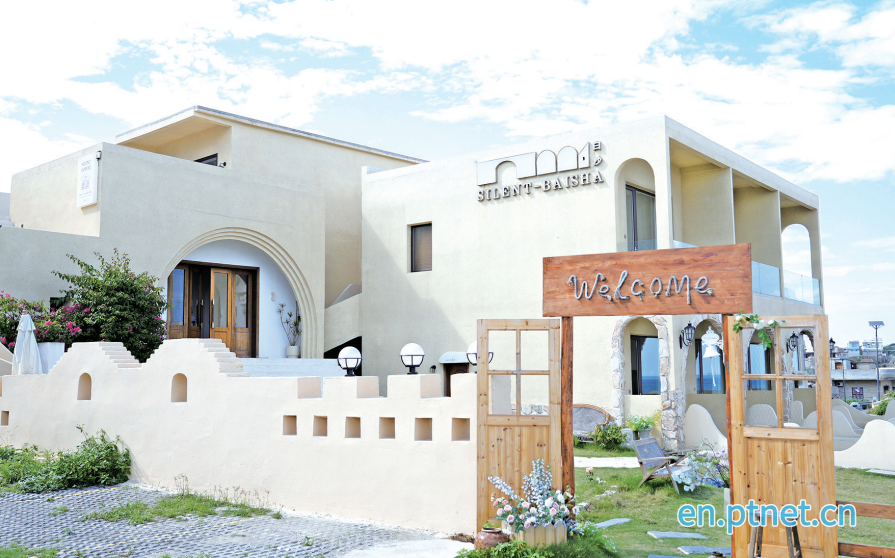
Exterior view of the homestay

A corner of the homestay
Pingtan, China's second international tourism island after Hainan and located off the coast of Fujian Province, has become a testing ground for new forms of coastal travel. In Baisha Village, a humble guesthouse called Silent Baisha stands between the mountains and the sea, beckoning visitors to an intimate island sojourn.

Gao Pan making coffee

Delicacies served at the homestay
The boutique property was created by Gao Pan, a Pingtan native who left a management career at a five-star hotel in Shenzhen and returned home to renovate four scattered stone houses. Over three years, he and his partners transformed the aging structures into a unified space that blends island landscapes, personal memory and understated design.
"Many people see it for the first time and ask where this is, because it doesn't look like Pingtan," Gao said, explaining his original idea. "What I wanted was a sense of calm that lets people step out of everyday life the moment they arrive."
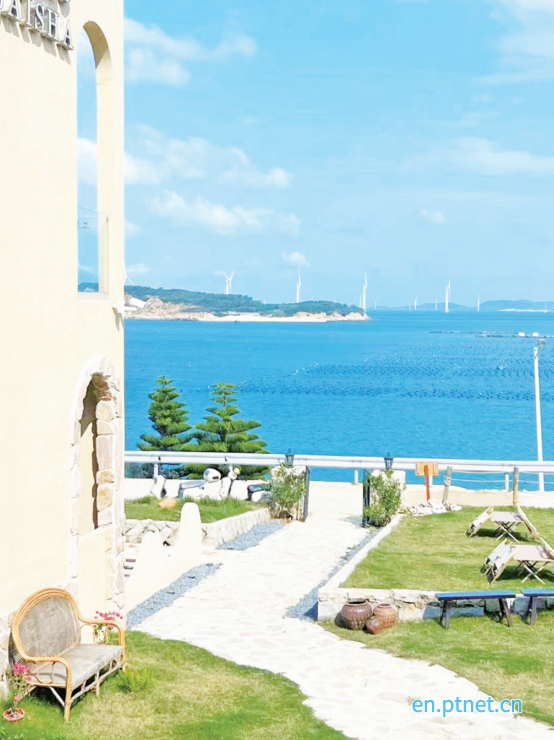
An endless sea stretches beyond the house
There is no conspicuous sign at the entrance. Inside, cream-colored walls, earth-toned ceramics and arched corridors frame uninterrupted views of the sea. Sunlight functions as a central design element, shifting across a looped, courtyard-style corridor that links the four buildings. "The light and shadow there change constantly. It feels alive," said Chen Man, a photographer from Hangzhou who frequently shoots at the property. "I often let models walk freely through the corridor. The results are always strong."
Public areas cover nearly 1,000 square meters, including a pool aligned with the horizon, a lawn used for sunset picnics and film screenings, and a café furnished with vintage lamps, wooden shelves and objects collected from different places. The mood is deliberately restrained, allowing guests to settle into the rhythms of the island.
A defining feature lies in the names of its 11 guest rooms. Each is named after an island or reef visible from different vantage points around Baisha Village. "These names come from the islands and reefs we can see from here," Gao said, pointing toward the sea. "When someone stays in the room called Shihui, for example, it's not that they can see Shihui Island directly. But we want them to feel a connection—to look it up on a map, to imagine it at sunrise or sunset. It's like claiming a small island of your own."
The project began to take shape in 2019, when Gao decided to return home. "When I chose my major, I already thought Pingtan would develop around tourism," he said. "And living elsewhere, I never really felt a sense of belonging." After reconnecting with friends who had opened some of the village's earliest guesthouses, the group settled on renovating four old homes together.
The early stages were difficult, involving permits, negotiations with villagers and repeated revisions of the overall concept. "At the beginning, everything was hard," Gao recalled. During that period, the team often reminded each other to "quietly do this one thing well," a phrase that eventually inspired the name Silent Baisha.
Rather than outsourcing the design, the team drew plans themselves and linked the four houses with a square-loop corridor. For Gao, the character "hui," meaning "return," held particular emotional weight on Pingtan. The courtyard plants, the turns of the corridor and the pacing of the space reflect that sentiment.

Group photo of Gao Pan (far right) with his team
As the buildings changed, so did Gao's role. He shifted from hotel manager to guesthouse host, combining standardized service practices with local warmth. "Hotels want homestay soul; homestays want hotel quality," he said. "We try to find a balance that is professional but still human."
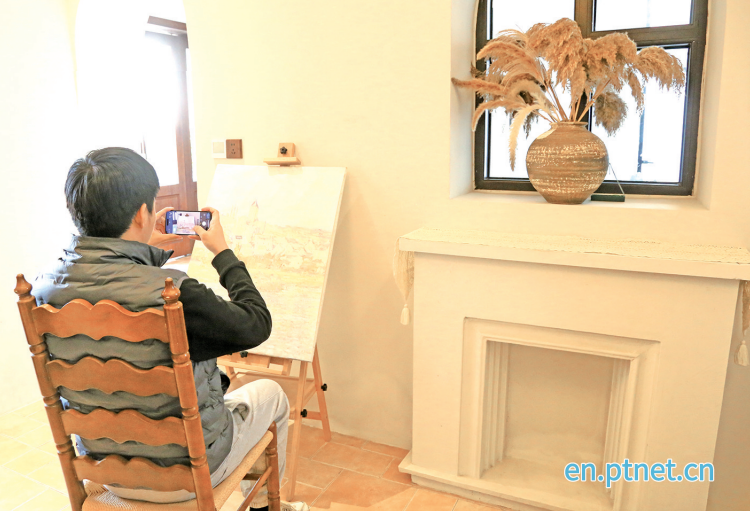
Tourists taking photos
For many guests, that balance defines the experience. Aiguli, a visitor from Xinjiang, planned to stay three days but ended up remaining for two weeks. "I'm used to the vast Gobi, but the openness of the sea gave me a different kind of healing," she said. "I read in the café, walk along the coastal road in the evening, and feel very calm."
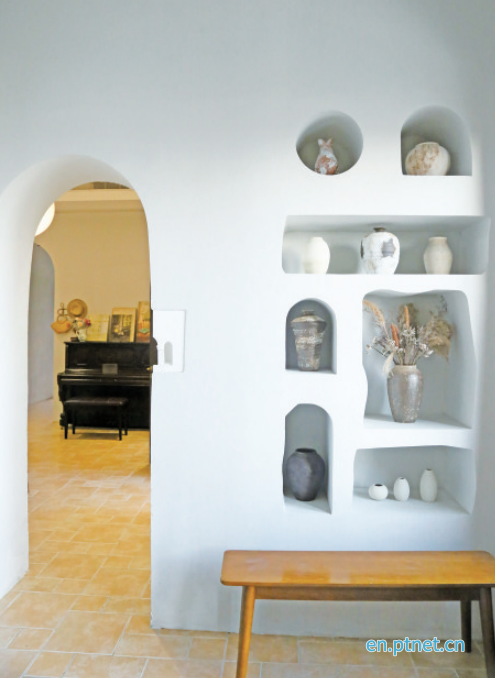
A collection of curated artworks displayed indoors
Li Wei, an office worker from Shanghai, said the details mattered most. "We came for the arches and the pool," she said. "But what stayed with me was how the staff talked about the islet my room was named after, or how someone quietly brought mosquito repellent during an outdoor movie night. You don't feel like a customer here. You feel like a guest."

Stunning sea views visible from the room
As dusk settles over Baisha Village, visitors gather outdoors to watch the sea darken or talk softly among themselves. Silent Baisha absorbs the sound of waves, wind and conversation, offering a place where time loosens its grip and the island's stillness speaks for itself.


 Fujian Public Security Registration Code: 35012802000271