

Keqiutou branch of Chinese Archaeological Museum marks first anniversary in Pingtan
en.ptnet.cn | Updated:2026-04-15 | Lin Kongbo, StephaniePingtan, located on China's southeast coast facing the Taiwan Straits and known as a key hub for Austronesian culture research and coastal tourism, celebrated the first anniversary of the Keqiutou branch of the Chinese Archaeological Museum on April 9, 2026. Jointly established by the Chinese Archaeological Museum and the Pingtan Comprehensive Pilot Zone, the museum has become a major landmark for exploring, exhibiting and spreading Austronesian civilization.
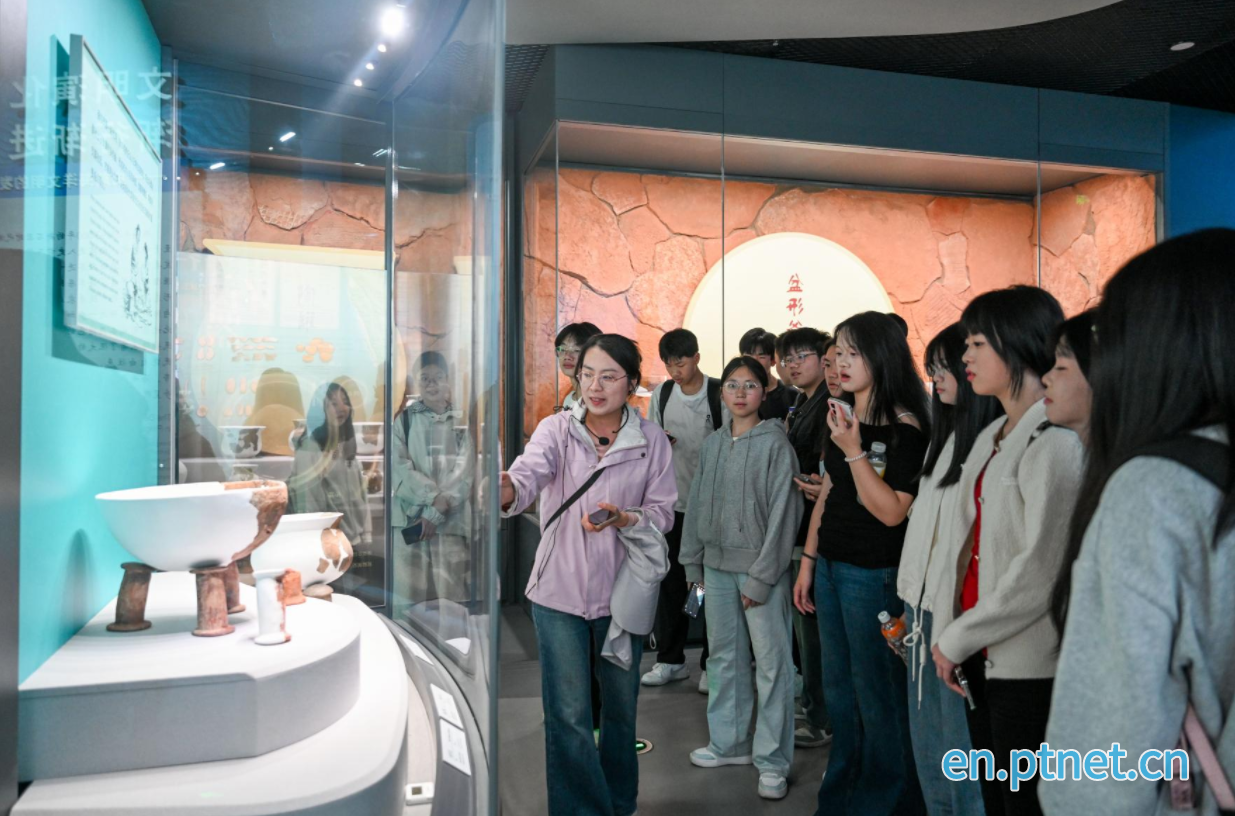
Students participating in the study tour are visiting the Keqiutou Site Museum.
Covering 13,500 square meters, the museum features three themed exhibition halls, displaying more than 600 pieces of pottery, bone and shell artifacts that trace 7,500 years of prehistoric history. With naked-eye 3D technology and immersive experiences, visitors are transported back to prehistoric times to see ancient ancestors fishing, hunting, and sailing across the sea. In its first year, the branch has welcomed over 100,000 visitors and more than 300 domestic and international delegations.
Academic research stands at the core of the museum's work. Over the past year, the Pingtan International Austronesian Research Institute, together with the Institute of Archaeology of the Chinese Academy of Social Sciences and Xiamen University, has advanced the major research project Archaeological China: Origin and Diffusion of Austronesian Peoples. The team has refined the prehistoric cultural sequence of China's southeast coast dating from 7,500 to 3,000 years ago, with physical evidence including pottery shards, shell mounds and house foundations providing solid archaeological proof that Austronesian peoples originated in southeast China.
Fan Xuechun, president of the Pingtan International Austronesian Research Institute, stated that relying on the Austronesian and Maritime Civilization Committee of the Alliance for Cultural Heritage in Asia and the Keqiutou Site Museum, the branch has built academic exchanges and cooperation with many Austronesian nations in the South Pacific, Southeast Asia and the Indian Ocean. It has established sister-museum ties with the Bowers Museum in the United States and the Tahiti Museum in Tahiti, and is promoting friendly cooperation with research institutions and universities in Tonga, Papua New Guinea, and other countries.
The museum also strives to bring ancient civilization closer to the public. It launched the Austronesian Culture Into Campus campaign, holding more than 50 offline activities covering over 20,000 participants. Its online short video series Keqiutou Prehistoric Code has garnered over one million views at most. Cultural and creative products such as pottery-pattern coffee mugs and wave-pattern canvas bags have also been developed. In November 2025, the museum was listed as a Fujian provincial international cultural exchange base and a cultivation center for enhancing the sense of community among the Chinese nation. It is also building a visitor service center and archaeological experience area to integrate heritage sites, culture and tourism.
Lin Ying, director of the Academic Exchange Department of the Pingtan International Austronesian Research Institute, said, "We have built a rich interactive platform for visitors through naked-eye 3D technology and immersive experiences. Next, we will continue to develop the museum's brand identity, develop a series of cultural products, and integrate them with social education and campus activities to allow more people to experience Austronesian culture."
Li Lei, deputy curator of the Keqiutou Site Museum, noted that as the first branch of the Chinese Archaeological Museum, the past year's cooperation has boosted Pingtan's cultural and heritage cause. Moving forward, the museum will focus on building an international Austronesian cultural brand, speed up the construction of archaeological site park facilities, deepen academic cooperation with Southeast Asia and Pacific island countries, launch international exhibitions and cultural products, and turn Keqiuqiuo culture into a shining icon for Pingtan to reach the world.