
A teacher's lens captures the fleeting beauty of Pingtan Island
en.ptnet.cn | Updated:2026-04-23 | Lin Kongbo, Stephanie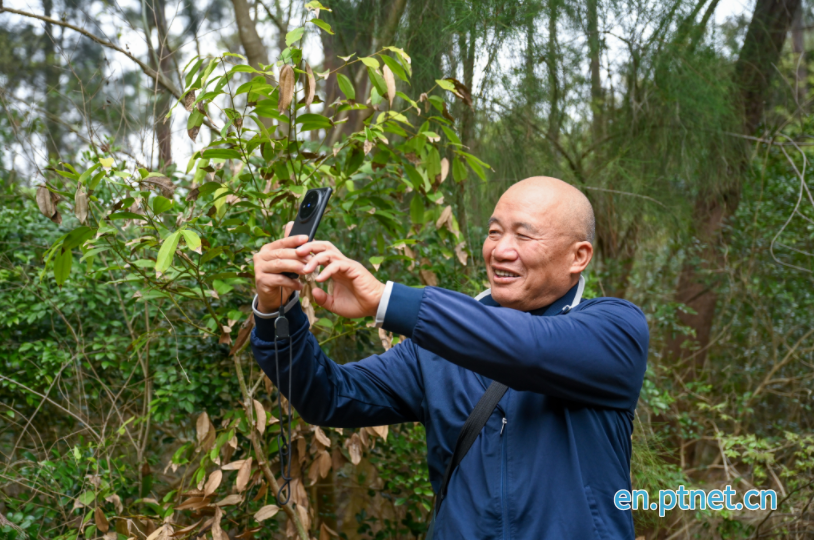
Li Haiyun holds up his camera to capture the moment.
Pingtan, a scenic island county in Fujian Province across the Taiwan Straits, is known for its rugged coastline, fishing villages and ever-changing seaside landscapes. For one local teacher, the island is also a living gallery—best explored not with heavy gear, but through the simplicity of a smartphone lens.
Li Haiyun, a middle school teacher in Pingtan, has earned a reputation among friends as a "wandering photographer." Since 2021, he has spent his spare time walking the island's shores, documenting rock formations, coastal light and everyday village life. Over the years, he has taken thousands of photos, attracting more than five million views on the photo-sharing platform Meipian.
"Pingtan is more than blue seas and clear skies," Li said. "Every rock, every overlooked corner, holds a story."
His journey began with a moment of revelation. After seeing striking images of local rock formations taken by another photographer, Li realized that the familiar scenery he once overlooked could be rediscovered through a camera. Guided by experienced photographers, he gradually learned to observe texture, shape and light—skills that reshaped how he saw his hometown.
Progress did not come easily. "At first, I didn't understand composition or lighting. Many photos turned out blurry or lifeless," he recalled. "There was a time I spent an entire morning trying to photograph one rock, and none of the shots worked." Still, he persisted, encouraged by the advice that photography demands patience and constant practice.
Support from his family also played a key role. His wife, initially concerned about his long hours outdoors, eventually came to understand his passion. "Photography is not just a hobby for me—it's a way to relax and connect with nature," Li explained.
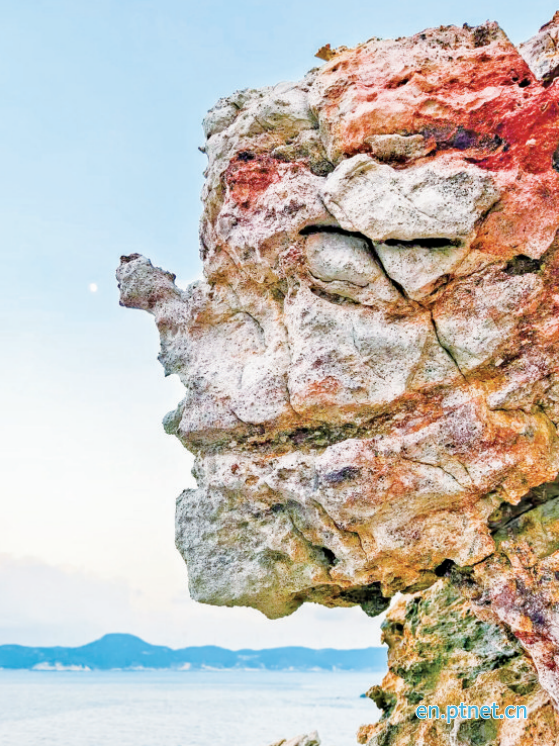
A peculiar rock stands by the sea, carved by thousands of years of sea winds and waves into a natural silhouette of a human face.
Over time, Li's lens has captured both change and continuity. Coastal formations shift with wind and tide, while familiar landmarks take on new forms. He once documented a rock known locally as the "human-shaped stone," which later evolved into a natural stone arch due to environmental changes. "It didn't disappear—it transformed into something even more spectacular," he said.

A white dog stands quietly before mottled stone walls, looking up at the lens.
Many of his most memorable images are unplanned. In one photograph, the silhouette of a rock resembles a human face, perfectly aligned with a crescent moon. In another, a small white dog stands framed by autumn leaves and an old stone house, creating a quiet, intimate scene of rural life. "With a phone, you can capture a moment instantly," Li said. "That's the beauty of it—you don't miss what's right in front of you."
Despite growing recognition, Li remains deliberately low-key. He has declined paid submissions and avoids joining photography associations, preferring the freedom to shoot independently. "I don't do this for fame or profit," he said. "I just enjoy walking, observing and recording real life on the island."
Each image he shares is carefully labeled with time and location, often accompanied by short travel notes. For Li, the value of photography lies not in online traffic, but in preserving fleeting moments. "Every click of the shutter freezes a piece of time for my hometown," he said.
Looking ahead, he hopes to upgrade to a professional camera to better capture challenging scenes such as bioluminescent "blue tears" and expansive coastal wind farms—subjects that remain difficult to photograph on a smartphone.
Yet his approach remains unchanged: return to the same spot, wait for the right light, and embrace the unpredictability of nature. "The joy of taking a good photo," he said, "is something nothing else can replace."


 Fujian Public Security Registration Code: 35012802000271