
A tea artist in Pingtan creates a space to slow down
en.ptnet.cn | Updated:2026-04-30 | Lin Kongbo, Stephanie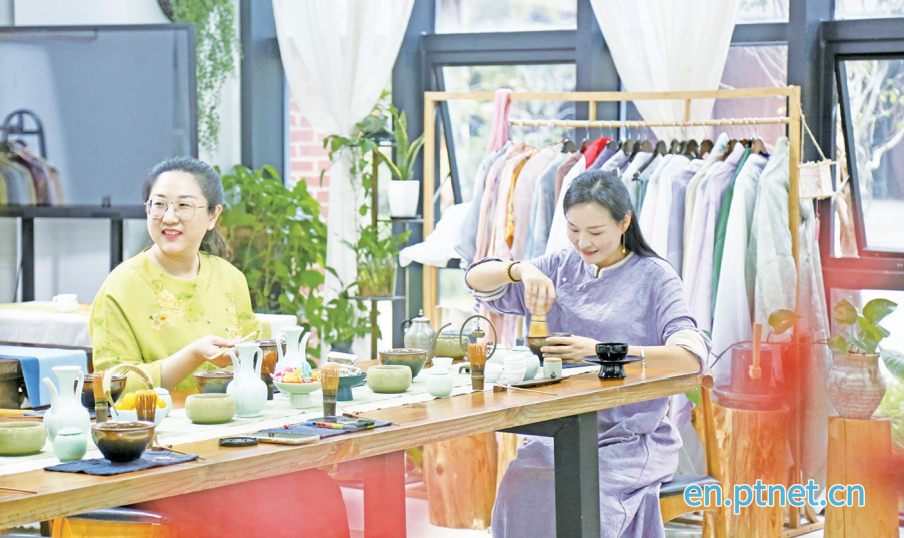
Wei Nuoyan (right) demonstrates Song Dynasty tea whisking
Facing the Taiwan Straits, Pingtan is a coastal island city in Fujian known for its growing cultural scene and cross-Straits exchanges. Among its emerging voices is Wei Nuoyan, a practitioner of traditional Song Dynasty tea preparation, who is creating a quiet space for reflection in a fast-paced world.
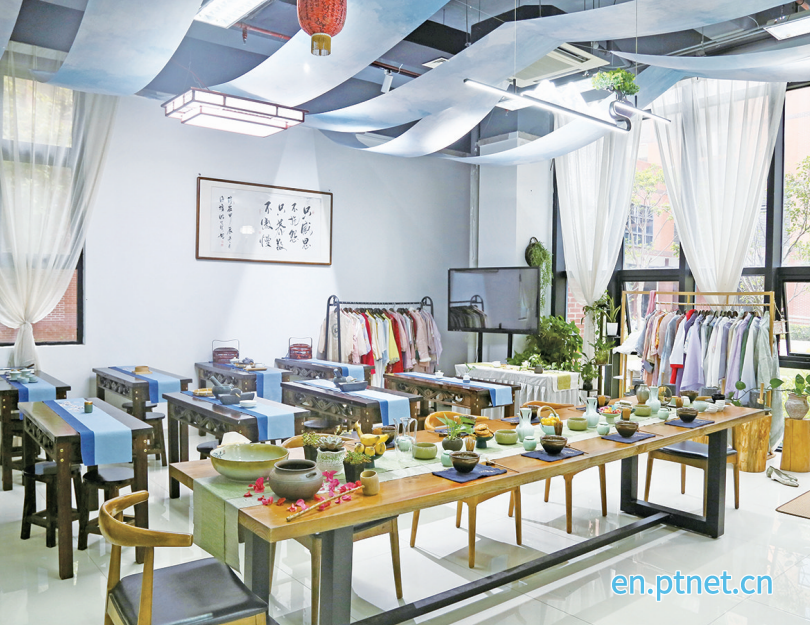
A view of Songfeng Yayun Cross-Straits Tea Academy
Wei, born in the 1980s, is the founder of Songfeng Yayun Culture Development Co., Ltd. and head of the Songfeng Yayun Cross-Straits Tea Academy. Through teaching tea preparation, painting and Zen-inspired movement, she hopes to offer people "a place to slow down"—a space that heals both visitors and herself.
Inside her tea academy, located in the Pingtan Taiwan Entrepreneurship Park, the first thing visitors notice is the sound. A bamboo whisk taps rhythmically against a ceramic bowl, producing a soft, even rustle. Sitting behind the tea table in simple attire, Wei steadily whisks powdered tea in a dark-glazed bowl until a thick, snow-like foam forms on the surface.
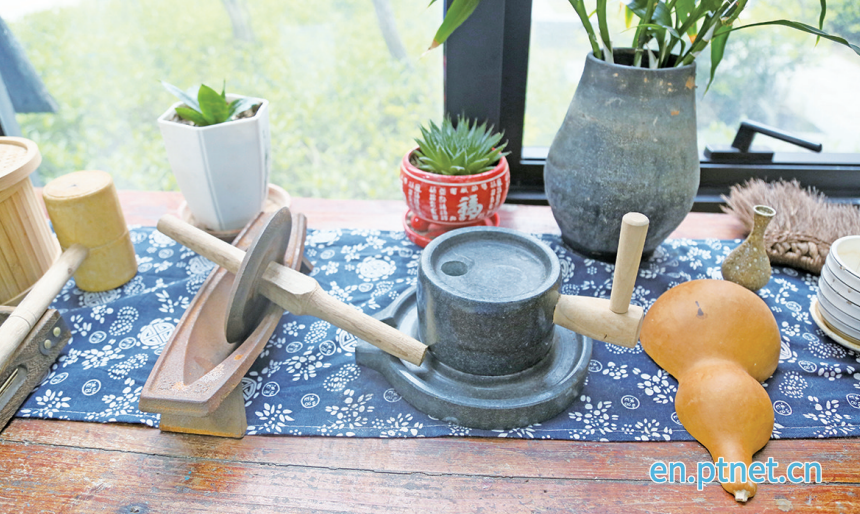
Display of traditional tea grinding tools
She is demonstrating the traditional "three pours" method of Song-style tea preparation. After warming the bowl and preparing the paste, hot water is added in stages, with careful whisking each time.
"Three pours are enough," she said with a smile. "What matters is not how many times you pour, but how attentively you experience each moment as water meets tea."
For Wei, tea is not about speed or competition, but about focus and balance.
Her journey into tea culture began during a difficult period in her life. Years ago, an accident left her feeling lost, until a traditional culture class introduced her to a different way of thinking. A teacher's remark stayed with her: "The value of life should not rest solely on material gain."
"I had never thought about life that way before," Wei said. "We are taught to strive and compete, but not what to do if we achieve everything and still feel unhappy."
Learning tea preparation proved demanding. She practiced the whisking motion hundreds of times, refining wrist angles, water flow and rhythm. At one point, she doubted herself, but persistence paid off. Today, she can complete the process with ease, producing a smooth, fragrant tea with a lasting aftertaste.
Beyond tea, Wei's daily routine revolves around careful planning and cultural outreach. Each morning, she prepares a bowl of tea for herself as a way to settle her mind.
"This is my way of grounding myself. For about ten minutes, I focus only on the movement. By the time the tea is ready, I feel calm," she said.
Beyond hosting visitors, she organizes classes, cultural events and cross-Straits exchange programs. She has worked with universities and community organizations to promote traditional culture, offering public workshops for children and young people, as well as tea experiences for visitors from across the Taiwan Straits.
Operating a tea academy in a niche field is not without challenges. "Some days are busy, some are quiet," she said. "But as long as I can sustain it, I will continue. What I need is not high profit, but the space to keep doing this."
To support operations, she collaborates with local businesses and organizes team-building activities, introducing tea culture in accessible ways.
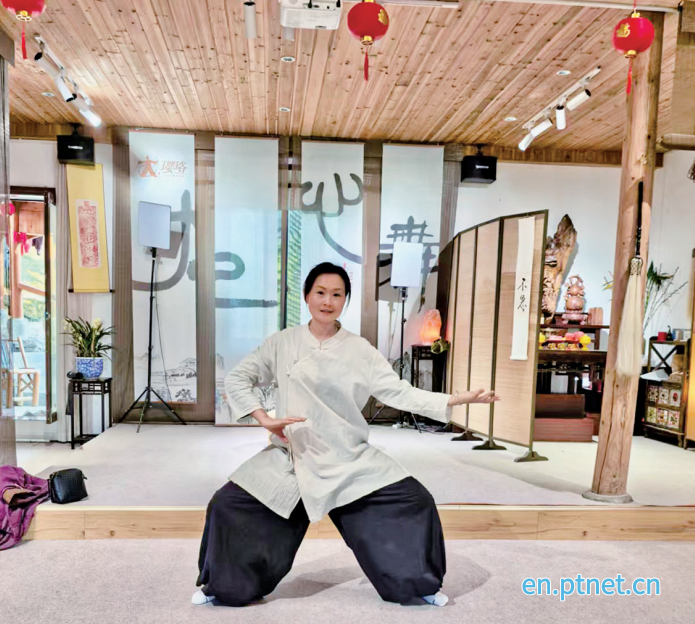
Practicing Zen-inspired dance
Wei also practices Zen-inspired dance, which she describes as a way to reconnect with the body. "It's not about performing for others, but about listening to yourself," she said.
She recalls a young visitor who, after trying tea preparation, sat quietly for a long time before saying, "I never knew what it felt like to truly be calm."
"Many people don't lack the need for stillness—they've just never experienced it," Wei said. "If they can sit here for an hour, doing nothing but drinking tea and watching the view, then I feel I've done something meaningful."
Looking ahead, Wei hopes to build a public space dedicated to relaxation and reflection, where people can drink tea, read and unwind.
"Life doesn't have just one path," she said. "I hope everyone can find their own way of living—one that feels true to themselves."


 Fujian Public Security Registration Code: 35012802000271