

Cross-Straits scholars spotlight Austronesian origins at Pingtan forum
en.ptnet.cn | Updated:2026-06-17 | Lin Kongbo, Stephanie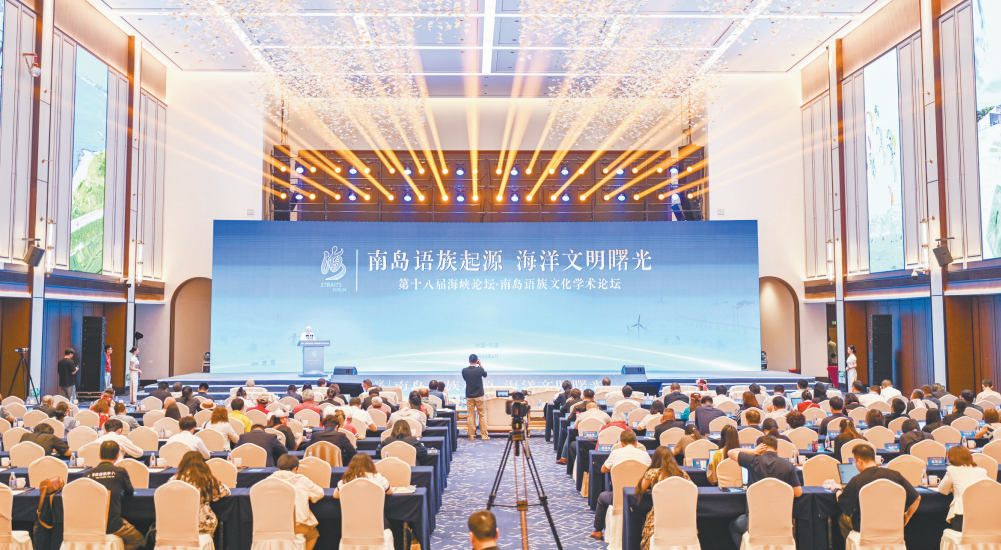
The 18th Cross-Straits Forum·Austronesian Culture Academic Forum was held in Pingtan on June 16, bringing together scholars from across the Taiwan Straits to discuss the origins and development of Austronesian peoples through an interdisciplinary lens.
Featuring experts in archaeology, museum studies, genetics and related fields, the forum highlighted the growing role of cross-disciplinary research in deepening understanding of Austronesian history. Participants reviewed key academic developments and shared the latest findings, further strengthening the groundwork of Austronesian origin studies.
During the keynote session, Fu Qiaomei, deputy director of the Institute of Vertebrate Paleontology and Paleoanthropology at the Chinese Academy of Sciences, presented research on ancient genomes and prehistoric population movements in southern East Asia. Her findings demonstrated how archaeogenomics is helping reconstruct the evolutionary history of prehistoric populations and provided new biological evidence for the formation and expansion of Austronesian peoples.
Chang Shan-nan, former director of the Taiwan Museum of Prehistory, discussed how museums can enhance public engagement with Austronesian culture through innovative storytelling and communication, enabling academic research to play a greater role in cultural preservation.
Wei Jian, distinguished professor at Minzu University of China and dean of the Institute of Frontier Archaeology, drew on archaeological discoveries at the Keqiutou site in Pingtan to support the view that Austronesian peoples originated from Fujian before expanding across the seas. Wang Yichun, vice chairman of the Taiwan Straits Ethnic Culture Foundation, called for stronger cultural exchanges and heritage protection efforts involving ethnic minority communities on both sides of the Taiwan Straits.
Zhang Wenjie, associate dean of the School of History and Cultural Heritage at Xiamen University, shared findings from isotopic and chronological analyses of the Xiying archaeological site. The research revealed evidence of human adaptation to marine environments along China's southeastern coast around 7,500 years ago.
"Through a series of studies, we have gained a clearer understanding of how the early inhabitants of Pingtan developed extensive knowledge of the sea and diversified ways of obtaining marine resources over generations," Zhang said. "These developments provided the material and survival foundations that enabled the ancestors of Austronesian peoples to gradually spread from the southeastern coast of China to offshore islands."
Scholars from both sides of the Taiwan Straits agreed that research into the origins and dispersal of Austronesian peoples is not only an important academic pursuit in archaeology and anthropology, but also a cultural bridge that fosters mutual understanding and strengthens connections among people across the Straits. They expressed hope that future interdisciplinary and cross-regional cooperation would continue to deepen and open new chapters in Austronesian studies.